Understanding River Flow: What CFS Means and Why It Changes Everything About Your Rafting Trip
TL;DR: CFS (cubic feet per second) measures how much water is flowing down the river, and it's one of the biggest factors determining what your rafting trip will be like. A single cubic foot is about the size of a basketball, and at 1,000 CFS, roughly 1,000 basketball-sized cubes of water—weighing about 62,000 pounds—rush past a single point every second. Higher flows create faster currents, bigger waves, and more powerful rapids, while lower flows make the river more technical or relaxed depending on the section. Because the Roaring Fork is a free-flowing, undammed river, conditions change throughout the season based on snowpack and weather. Experienced local guides use daily CFS readings to choose the safest and most enjoyable trips, ensuring every adventure is matched to current river conditions.
Every morning before any Thunder River Adventures trip departs, Chris or Kate Edmonds checks the USGS gauge for the Roaring Fork near Aspen. The number they find -- measured in cubic feet per second, or CFS -- shapes every decision that follows: which rapids will behave which way, which sections are appropriate for which guests, whether the day looks like the plan that was made at booking or whether it needs to be reconsidered.
CFS is a concept that river professionals think about constantly and guests rarely consider. Understanding it will make you a better-prepared guest and help you understand why your Roaring Fork experience in late June is genuinely different from the same trip in late August -- even if the river looks similar from the road.
What CFS Means
CFS stands for cubic feet per second -- a measurement of the volume of water passing a fixed point on the river every second. One cubic foot of water weighs approximately 62 pounds. At 1,000 CFS, that means roughly 62,000 pounds of water is moving past the gauge every second. This is why high-water rivers carry the kind of power that demands respect: the physics are real, and they don't negotiate.
The Roaring Fork is an undammed, free-flowing snowmelt river -- one of the only rivers of its size in Colorado with no dam controlling its flow. This means its CFS reading is determined entirely by snowpack depth in the mountains above Aspen and the temperature of the spring thaw. There is no release schedule, no reservoir drawdown, no management. The river does what the mountains tell it to do.
The Slaughterhouse Section Across Flow Levels
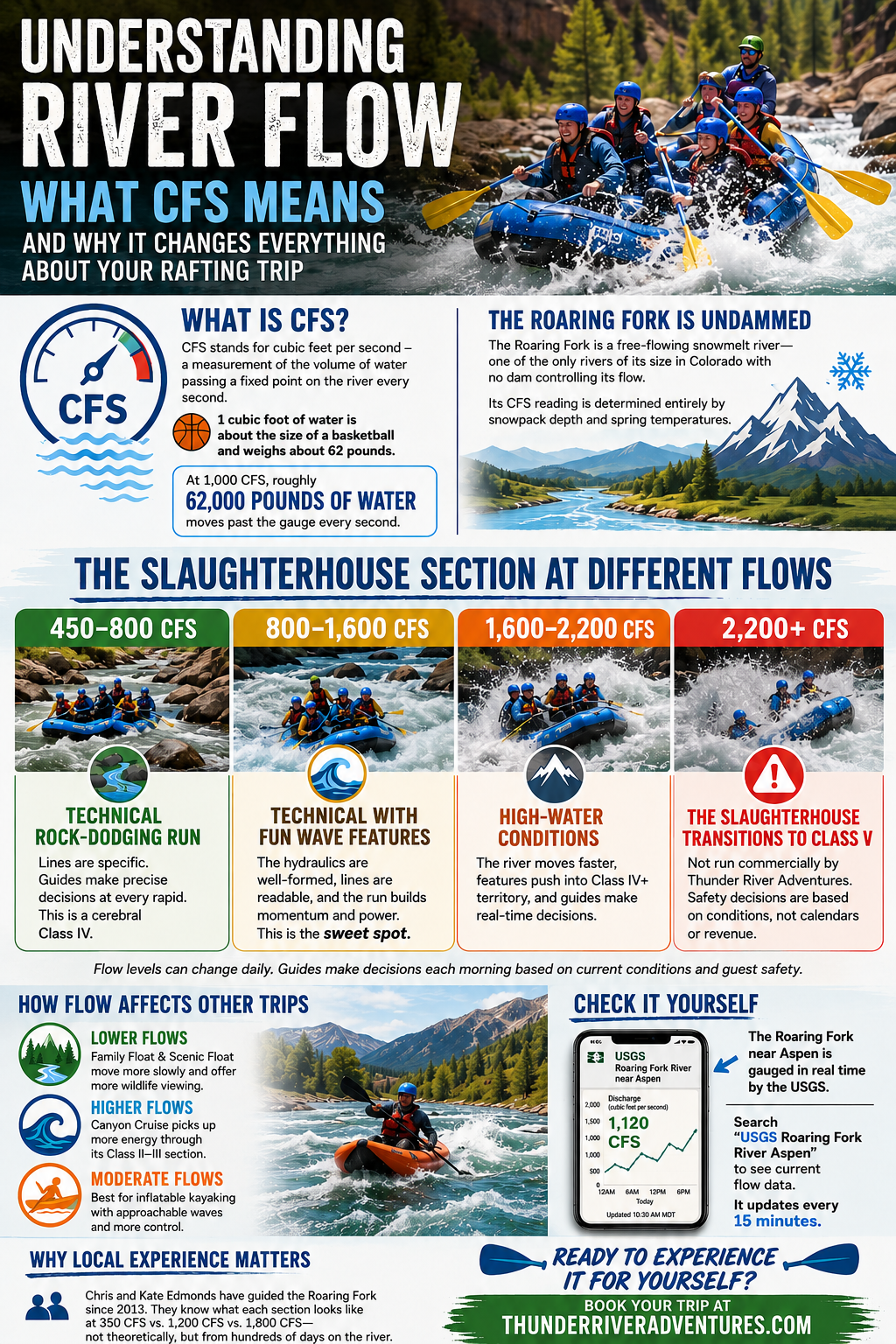
Here is how Chris and Kate describe the Slaughterhouse section -- the Roaring Fork's Class IV run -- at different CFS levels:
450-800 CFS: A technical rock-dodging run. Lines are specific. Guides make precise decisions at every rapid. The seven rapids -- Entrance Exam through Hawaii Five-O -- each present distinct technical challenges that require skill and reading. This is a cerebral Class IV.
800-1,600 CFS: Technical with fun wave features. The hydraulics are well-formed, the lines are readable, and the run builds momentum and power across its four miles. This is generally the sweet spot for guided Slaughterhouse trips.
1,600-2,200 CFS: High-water conditions. The river moves faster, features push into Class IV+ territory, and guides are making real-time decisions based on what the water is doing that day. The Roaring Fork in this range is a powerful experience.
2,200+ CFS: The Slaughterhouse section transitions to Class V at these flows and is not run commercially by Thunder River Adventures. This decision is made based on conditions and guest safety -- not calendars or revenue. When the river is too high to run safely, we don't run it.
How This Affects Other Trips
The CFS reading doesn't just affect Slaughterhouse. At lower flows, the Family Float and Scenic Float trips move more slowly. and offer more wildlife viewing time along the banks. At higher flows, the Canyon Cruise picks up significantly more energy through its Class II-III section. Inflatable kayaking -- best on the Roaring Fork when flows are moderate and the river is approachable for independent paddling -- shifts in character as flows rise.
This is why booking with experienced, locally-based guides matters. Chris and Kate have been on the Roaring Fork since 2013. They know what each section looks like at 350 CFS vs. 1,200 CFS vs. 1,800 CFS -- not theoretically, but from direct experience across hundreds of trips. That knowledge is what shapes the decision each morning before any guest gets in a raft.
Check It Yourself: The Roaring Fork near Aspen is gauged in real time by the USGS. Search 'USGS Roaring Fork River Aspen' to see current flow data. It updates every 15 minutes and is publicly available.
Ready to Experience It for Yourself?
Book your trip at thunderriveradventures.com -- our guides handle the conditions